Abstract
Recommender systems represent one of the most impactful applications of AI in the modern era, shaping everything from global commerce to information consumption. This course offers a comprehensive look into their evolution, navigating the path from classical matrix factorization to current deep learning and the emerging frontiers of neuro-symbolic and agentic approaches. Moving beyond simple accuracy, the curriculum adopts an interdisciplinary lens to tackle systemic challenges, including fairness, transparency, inclusion, and the growing divergence between offline metrics and real-world impact. In light of the EU AI Act, we will critically examine how to build trustworthy systems that align with societal values. Participants will move beyond algorithmic implementation to develop a sophisticated research mindset, equipping them with the conceptual toolbox necessary to navigate and shape the next generation of recommendation technologies.
Recommender Systems - Past, Present, and Future (Challenges)
Website for the ESSAI 2026 RecSys Crash Course
See: https://essai2026.eu/program.php#id-C10
General Infos
Reasons for taking the course:
- Learn about common recommendation algorithms and how they function.
- Gain insights into applied AI from an interdisciplinary perspective.
- Develop a critical reflection on the societal and ethical impacts of AI systems.
- Receive a conceptual toolbox to successfully design and develop future recommender systems.
Prerequisites:
- fundamental understanding of linear algebra
- some preliminary experience with neural networks
Structure
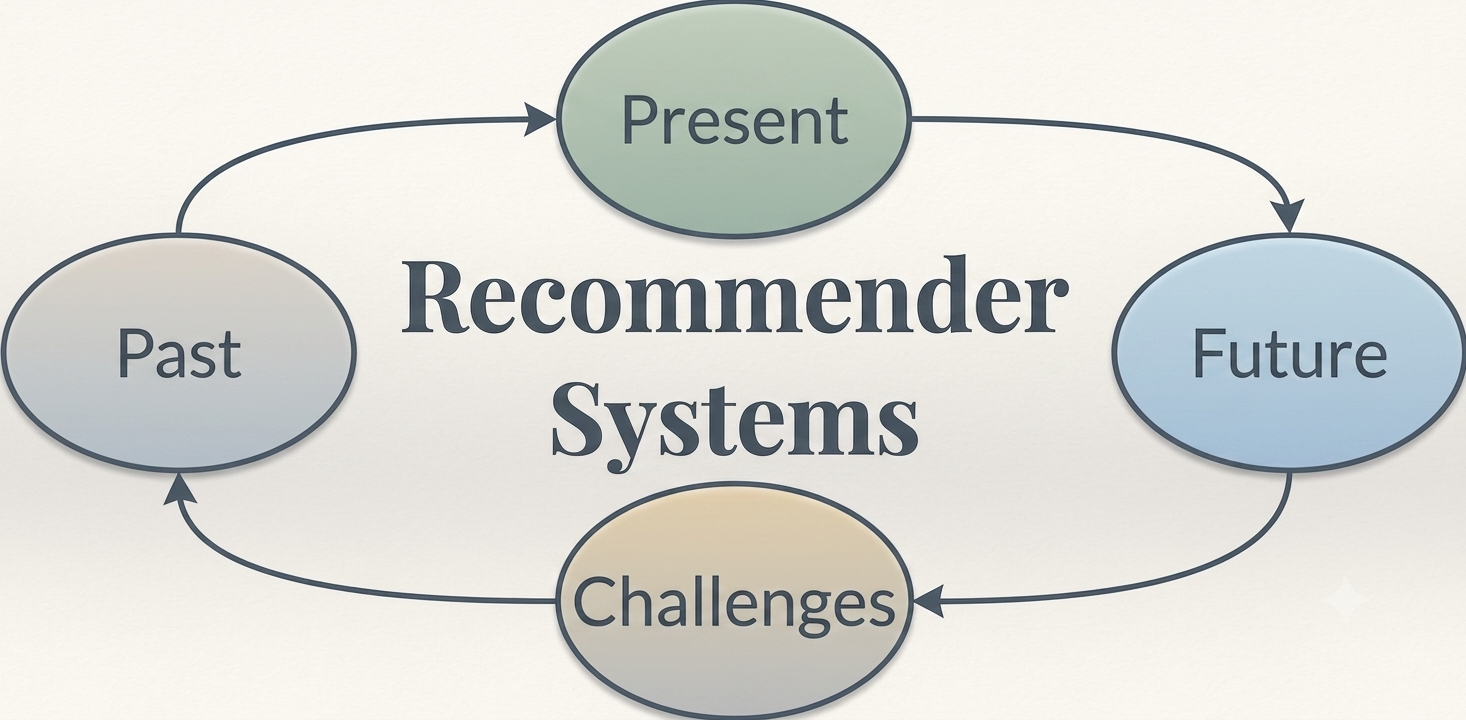
The course is structured in 4 units.
Unit 1: Introduction to Recommender Systems and Their History (PAST - traditional RecSys)
This unit will be taught by Prof. Dr. Lex
Example topics covered:
- Collaborative Filtering
- Netflix Prize
- Matrix Factorization
- Cold Start Problem
Unit 2: Matching Users with Items using Deep Learning (PRESENT - deep learning RecSys)
This unit will be taught by Dr. Reiter-Haas
Example topics covered:
- Neural Approaches
- Transformers for (Session-Based) RecSys
- Two Tower Model
- Side Information
Unit 3: Considerations beyond Optimizing Predictions (CHALLENGES - ethical and legal RecSys)
This unit will be taught by Prof. Dr. Lex
Example topics covered:
- Beyond Accuracy (Metrics)
- Trustworthiness in Light of the AI Act
- Inclusion and Non-Discrimination
- Biases in Algorithmic Predictions
Unit 4: Towards Agentic LLMs for Recommendations (FUTURE - agentic and neurosymbolic RecSys)
This unit will be taught by Dr. Reiter-Haas
Example topics covered:
- Cross-Domain Recommendations
- Neurosymbolic Integration
- ReAct Agents
- Hybridization Strategies
Materials
- Slides Part0 Organization
- Slides Part1 Past
- Slides Part2 Present
- Code for Part2 on Kaggle
- Slides Part3 Challenges
- Slides Part4 Future
- Example (mock) reasoning and MCP tool call for Part4
Recommended Readings
- Are we really making much progress? A worrying analysis of recent neural recommendation approaches
- Recommender Systems with Generative Retrieval
- Knowledge-aware Recommendations Based on Neuro-Symbolic Graph Embeddings and First-Order Logical Rules
- The Future is Agentic: Definitions, Perspectives, and Open Challenges of Multi-Agent Recommender Systems
About the Lecturers
Dr. Markus Reiter-Haas is a postdoctoral researcher at Graz University of Technology, applying his computer science expertise to ethical recommender systems within the Bilateral AI Cluster of Excellence and the AI for Society Lab. His current work focuses on using hybrid AI for adapting and diversifying recommendations, primarily in the news domain. In his previous postdoc position, he studied user behavior with randomized field experiments and large language models at the interdisciplinary Duke University’s Polarization Lab. In his PhD, he developed approaches for computational framing analysis using the Transformer models. Besides, he has prior experience in industry, building AI systems for job recommendations.
Markus has held several lectures in various settings. The most substantial examples are the hands-on deep learning and Transformers for retrieval and ranking lectures (Advanced Information Retrieval at Graz University of Technology). Besides, he held various guest lectures in interdisciplinary settings, such as within the Human-AI Co-Evolution course (Duke University) and Social Media Course (University of Graz), and was an invited speaker at the Know-Center summer school. From a didactic perspective, he took several advanced training courses and modules (~200h). Most notably, he completed a teaching expert certification, where his contribution, on presenting program code in the classroom for the Science Space Styria, was featured.
Univ.-Prof. Dr. Elisabeth Lex is a tenured full professor at Graz University of Technology (TUG). She is dean of study for the master’s program Computational Social Systems. She has a habilitation (venia docendi) in Applied Computer Science, and her postdoctoral thesis is on “Modeling and Predicting User Behavior in Web-based Systems”. Her areas of expertise include recommender systems, user modeling, behavioral analytics, information retrieval, machine learning, data science, and web mining. Elisabeth Lex received her Ph.D. in Computer Science from Graz University of Technology in 2011. After completing the Ph.D. program, she was a postdoctoral research fellow at Universidad National de San Luis, Argentina, and RWTH Aachen, Germany. Elisabeth was a work package leader in the FP7 IP Learning Layers project, in which she researched cognition-inspired recommender systems and task leader in the H2020 Analytics for Everyday Learning (AFEL) project, in which she researched psychology-informed recommender systems. Elisabeth was a member of the Expert Group on Altmetrics, which advised the European Commission, DG Research and Innovation. The expert group developed policies for the commission on how to use altmetrics to assess the impact of scientific artifacts. She has published more than 150 scientific publications in venues such as WebConf, HT, RecSys, UMAP, ECIR, ISMIR, as well as in journals such as Foundations and Trends in Information Retrieval, UMUAI, EPJ Data Science, Frontiers in AI, Transactions of the International Society for Music Information Retrieval (TISMIR), or the International Journal of Human-Computer Interaction. Elisabeth regularly gives invited talks about her research and acts as Senior PC member, PC member, co-organizer, track chair, and co-track chair at venues such as WebConf, IUI, RecSys, UMAP, Web Science, or HT.
Elisabeth is a passionate teacher at TU Graz, where she teaches Web Technology, Recommender Systems, Advanced Information Retrieval, and Computational Methods for Statistics. Furthermore, she held several tutorials within the recommender systems community and taught at the Recommender Systems summer school.